
 Script Planner Assistant▸
 AI Apps
 AI News
DeepSeek-V4 vs GPT-5.5 vs Opus 4.7: Three Flagship Models Clash in April 2026
小编 ·

DeepSeek-V4 vs GPT-5.5 vs Opus 4.7: Three Flagship Models Clash in April 2026
In April 2026, three top-tier models—DeepSeek, Claude, and GPT—were unveiled in succession. DeepSeek-V4 focuses on long context and low cost, Claude Opus 4.7 specializes in coding and logical reasoning, while GPT-5.5 offers a relatively balanced overall capability. This article compares these three models across three dimensions—coding, reasoning, and pricing—for your reference.
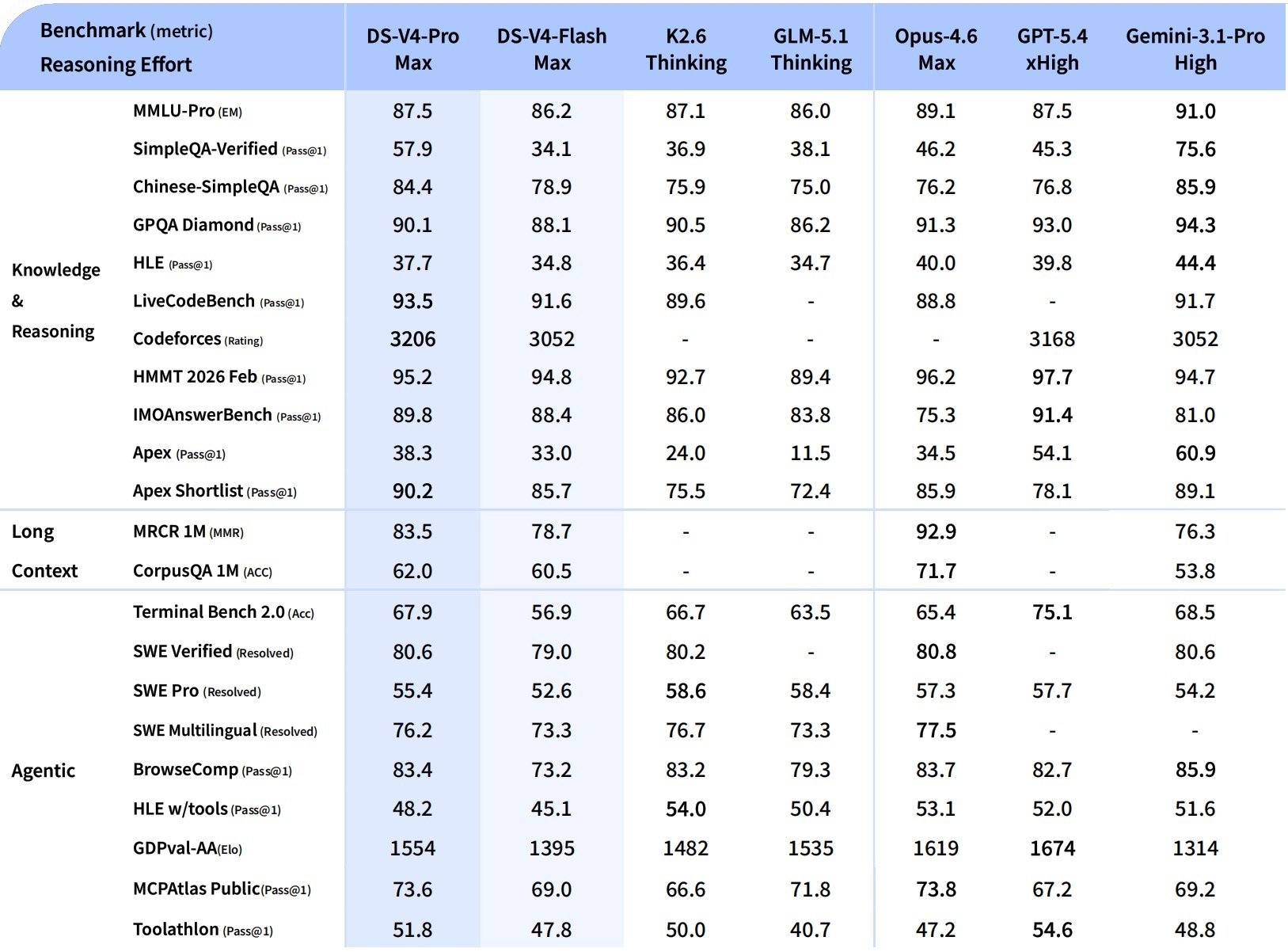
📊 Core Parameters and Capability Comparison
| Dimension | DeepSeek-V4 (Pro) | Claude Opus 4.7 | GPT-5.5 (xHigh) |
|---|---|---|---|
| Core Positioning | Ultimate cost-effectiveness + ultra-long context | Top-tier code engineering + rigorous logic | Comprehensive general capability + multimodal |
| Context Window | 1,000,000 (1M) | ~200K (standard) | ~128K - 400K |
| Coding Capability | SWE-Bench: ~80.6% | SWE-Bench: ~87.6% | SWE-Bench: ~75-80% |
| Math/Reasoning | Extremely strong (close to top closed-source) | Top-tier (self-correcting) | Top-tier (highest benchmark scores) |
| Multimodal | Text + images | High-resolution vision (3.75MP) | Native full-modal (audio/video) |
| Deployment | Open-source + API (private deployment supported) | Closed-source API | Closed-source API |
| Price | ¥4 / 1M tokens (input) | ~$35 / 1M tokens (input) | ~$70+ / 1M tokens (input) |
🧐 Detailed Analysis of Each
DeepSeek-V4: Long Context and Cost-Effectiveness
1M context is its core differentiator. If you need to process large volumes of financial reports, technical documents, or meeting transcripts in one go, V4 is a suitable choice. Its coding (SWE-Bench 80.6%) and math reasoning capabilities are no slouch, approaching GPT-5.5 in some scenarios. The input price is about 1/20 of GPT-5.5, offering significant cost advantages for enterprises with high-frequency API calls. Its shortcomings lie in multimodal (video/audio understanding) and complex creative writing, where it falls slightly behind Claude and GPT.
Claude Opus 4.7: Coding and Engineering
It reaches 87.6% on SWE-Bench Verified, significantly higher than other models. It can not only write code but also self-correct and plan, capable of handling demanding tasks like financial-grade code. On the vision side, it supports 3.75-megapixel image input, able to recognize complex chemical molecular structures or design blueprints. It pushes back against incorrect user viewpoints in technical discussions, more like an experienced colleague. Downsides: high price, no open-source version.
GPT-5.5: Relatively Balanced Overall Capability
It maintains 90+ scores on comprehensive leaderboards like MMLU-Pro, with stable performance in knowledge breadth and depth. The toolchain (DALL-E, Voice Mode) and third-party plugin ecosystem are relatively mature. But the price is too steep—for most ordinary applications, the performance premium may not be worth it.
💡 How to Choose
Choose DeepSeek-V4:
You need to handle ultra-long documents, such as legal dossiers, entire novels, or massive logs
You are a developer or startup sensitive to API costs, or require private deployment
You need a model with strong Chinese language capability and fast response
Choose Claude Opus 4.7:
Your core scenario is writing code, software development, or complex logical reasoning
You need strong instruction-following or visual analysis capabilities, such as analyzing design diagrams
You have sufficient budget and want the highest-quality code output currently available
Choose GPT-5.5:
You need a general-purpose assistant to handle complex problems across domains
Your workflow relies heavily on the Microsoft/Azure ecosystem
You need to process multimodal content like audio and video









