
 Script Planner Assistant▸
 AI Apps
 AI News
ERNIE 4.5 vs ERNIE X1: Features and Differences
小编 ·

ERNIE 4.5 vs ERNIE X1: Features and Differences
Baidu officially released ERNIE 4.5 and ERNIE X1 on March 16, 2025. Below are the features and differences between these two large models:
Features of ERNIE 4.5 and ERNIE X1
1. ERNIE 4.5
ERNIE 4.5 is Baidu's first natively multimodal large model. Its main features are as follows:
Multimodal Capabilities: It can process data in multiple modalities, including text, images, audio, and video. For example, it can understand image content and generate related textual descriptions, or generate corresponding images based on text.
Content Generation: It performs exceptionally well in content generation, producing content that is more realistic and accurate, making it suitable for creative writing, content creation, image generation, and other scenarios.
Performance Optimization: Compared with previous versions, ERNIE 4.5 shows significant improvements in multimodal understanding, generation quality, and performance.
Application Scenarios: Suitable for tasks that require handling multiple data types, such as ad creativity, video script generation, and intelligent customer service.
2. ERNIE X1
ERNIE X1 is a deep thinking model. Its main features are as follows:
Complex Problem Solving: It excels at handling complex logical reasoning and long chain-of-thought problems, and can better understand and solve complex tasks, such as solving math problems and logical reasoning questions.
Multi-tool Invocation: X1 supports multi-tool invocation and can autonomously call external tools (such as advanced search, document Q&A, AI drawing, code interpreter, etc.) to complete tasks, thereby providing more comprehensive solutions.
Outstanding Chinese Language Capabilities: It performs excellently in Chinese processing, skilled at Chinese knowledge Q&A, literary creation, official document writing, and other tasks, making it suitable for Chinese application scenarios.
Application Scenarios: Suitable for scenarios requiring deep thinking and complex problem solving, such as academic research, data analysis, and educational tutoring.

Differences Between ERNIE 4.5 and ERNIE X1
| Comparison Dimension | ERNIE 4.5 | ERNIE X1 |
|---|---|---|
| Model Positioning | The first natively multimodal large model, focusing on multimodal understanding and generation | Deep thinking model, focusing on complex problem solving and multi-tool invocation |
| Multimodal Capabilities | Strong multimodal understanding capabilities, able to process text, images, audio, video, and other content, generating more realistic content | Supports multimodal capabilities, can understand and generate images |
| Logical Reasoning Capabilities | Significantly improved logical reasoning capabilities | Strong long chain-of-thought reasoning, skilled at complex problem solving and logical reasoning |
| Tool Invocation Capabilities | Not explicitly mentioned | Supports multi-tool invocation, such as advanced search, document Q&A, AI drawing, code interpreter, etc. |
| Chinese Language Capabilities | Not explicitly mentioned | Outstanding Chinese capabilities, skilled at Chinese knowledge Q&A, literary creation, and official document writing |
| Performance Benchmark | Outperforms GPT-4.5 in multiple tests | Performance benchmarked against DeepSeek-R1 |
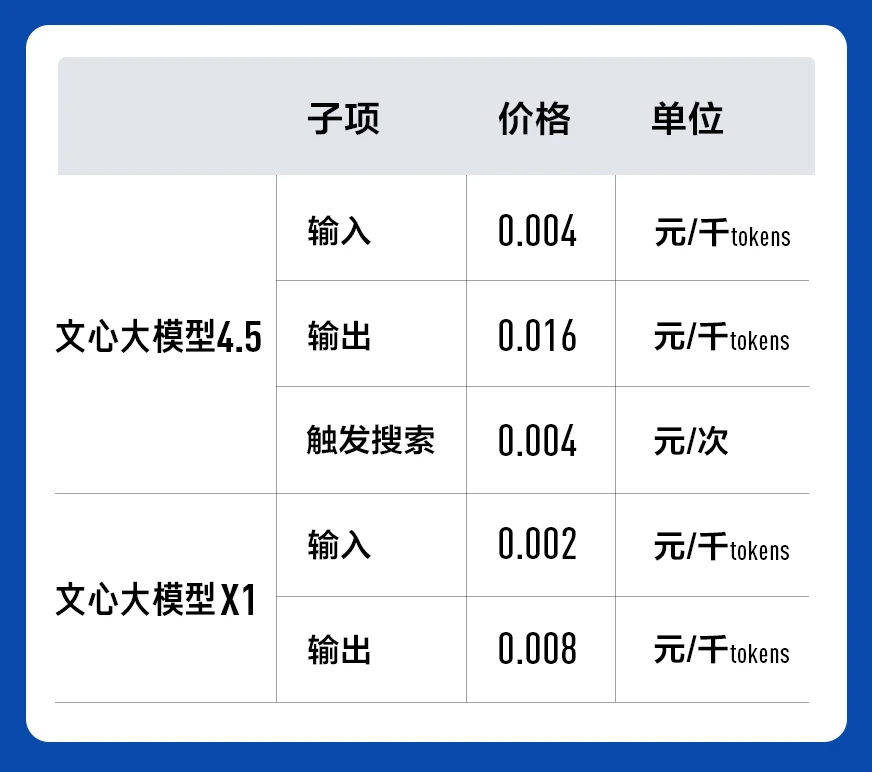
| API Pricing | Input 0.004 CNY per thousand tokens, output 0.016 CNY per thousand tokens | Input 0.002 CNY per thousand tokens, output 0.008 CNY per thousand tokens |
In summary, ERNIE 4.5 focuses more on multimodal understanding and generation, making it suitable for tasks involving multiple data types, emphasizing content realism and diversity.
ERNIE X1, on the other hand, focuses more on complex problem solving and logical reasoning, making it suitable for scenarios that require deep thinking and multi-tool invocation, especially excelling in Chinese language processing.









