
 Script Planner Assistant▸
 AI Apps
 AI News
DeepSeek V3 vs DeepSeek R1: What's the Difference and Which One Suits You?
小编 ·

DeepSeek V3 vs DeepSeek R1: What's the Difference and Which One Suits You?
The DeepSeek team has released two ai models: DeepSeek V3 and DeepSeek R1. The differences between them are quite significant.
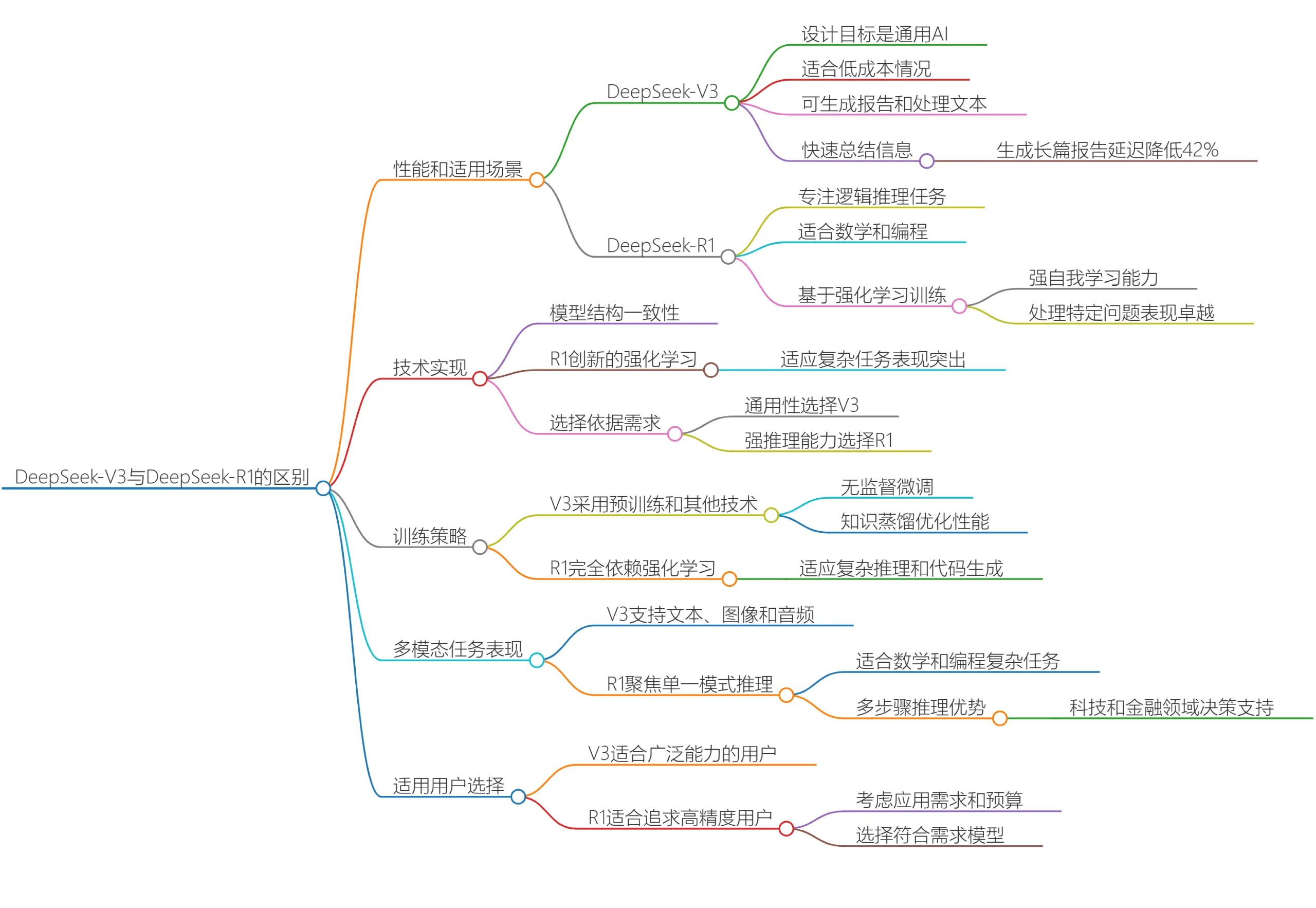
DeepSeek V3 is a general-purpose model, suited for scenarios with low cost requirements and a need for strong generalization capabilities. For example, it can quickly summarize key points from long reports. DeepSeek R1, on the other hand, excels at complex logical reasoning, mathematical computation, and coding tasks, thanks to its reinforcement learning training approach. The two models share some similarities in structure and parameters, but through different training techniques, each achieves its own optimized performance.
Model Positioning and Core Capabilities
DeepSeek V3 is a general-purpose large language model mainly handling natural language processing, knowledge Q&A, and content creation. It pursues a balance between high performance and low cost, making it well-suited for intelligent customer service, personalized recommendations, copywriting, and knowledge Q&A. V3 also employs algorithm optimization and multi-token prediction techniques to handle large-scale contexts, aiming to provide a cost-effective solution.
DeepSeek R1 is specifically designed for complex reasoning tasks, such as mathematical computation, code generation, and logical analysis. Powered by reinforcement learning, it delivers outstanding performance particularly in mathematics and programming, making it a popular choice for scientific research, engineering development, and high-end professional applications.
Training Methods and Technical Innovations
DeepSeek V3 adopts a traditional approach of pre-training combined with supervised fine-tuning, along with a Mixture-of-Experts architecture, which helps reduce training costs. It also leverages knowledge distillation to extract reasoning capabilities from R1, resulting in better output style and length.
DeepSeek R1 does not use supervised fine-tuning and relies entirely on reinforcement learning, particularly the GRPO algorithm. Through cold-start data and multi-stage reinforcement learning training, it emphasizes complete and accurate reasoning chains, enabling improved reasoning capabilities even with limited labeled data.
Performance
On math and code-related tasks, R1 performs exceptionally well, scoring higher than V3 on the AIME 2024 and MATH500 tests, and also achieving higher ratings on Codeforces, demonstrating its advantages in logical and mathematical reasoning.
On the other hand, on some knowledge-based benchmarks such as MMLU and GPQA, V3 falls slightly behind R1, but it outperforms R1 in long-form text generation and content creation.
Application Scenarios
Professional Domain Applications
-
With its general-purpose performance, DeepSeek V3 is an ideal choice for intelligent customer service, personalized recommendations, and long-text understanding and generation—for example, e-commerce platforms automatically answering customer inquiries.
-
Thanks to its outstanding reasoning capabilities, Deepseek-R1 is widely used in complex mathematical computation, code generation, and decision support scenarios—for instance, R1 is highly favored in professional fields such as finance and engineering.
Daily Interaction Scenarios
-
In daily chat and Q&A scenarios, DeepSeek-V3 provides more natural and reasonable responses, better adapting to different users' expression habits and needs.
-
DeepSeek R1 can also work in daily interaction scenarios, but may not match DeepSeek V3 in terms of response flexibility and accuracy.
Deployment and Optimization
Rise CAMP provides optimization support for both models, enabling one-click deployment and compatibility with many different types of GPUs/NPUs. V3 also features Mixture-of-Experts scheduling, while R1 offers high-performance inference acceleration, ensuring efficient operation for both.
DeepSeek V3 vs. DeepSeek R1 Comparison Table
| Comparison Dimension | DeepSeek-R1 | DeepSeek-V3 |
|---|---|---|
| Architecture |
|
|
| Training Algorithm |
|
|
| Training Data |
|
|
| Functional Focus |
|
|
Which One Is More Suitable for You?
Both DeepSeek V3 and DeepSeek R1 are optimized for different use cases. If you need a versatile a>to handle daily tasks like content creation or customer service, DeepSeek V3 is the ideal choice. When facing math problems, code writing, or in-depth logical analysis, DeepSeek R1 is the more specialized tool. As for which one suits you better, just pick the one that best fits your specific application scenario.









